

What Makes Sprint Weekends Different in F1 Fantasy?
Sprint weekends pack more scoring sessions into a shorter timeframe with an earlier team lock deadline. Instead of the standard Friday practice / Saturday qualifying / Sunday race format, sprint weekends add a sprint qualifying session and a sprint race that both award fantasy points. Your team locks before the sprint race on Saturday, not before qualifying. This earlier deadline means less practice data to work with and different strategic considerations.
In 2026, the F1 calendar includes six sprint weekends. Each one is an opportunity to score extra points, but only if you adjust your strategy for the compressed format.
TL;DR: Sprint weekends lock your team before the sprint race on Saturday, giving you less practice data. The sprint race awards 1-8 points for P1-P8, with a reduced -10 DNF penalty in 2026 (down from -20). Use the extra scoring session to your advantage by targeting drivers who excel in shorter races and treating sprint qualifying results as a preview of Sunday's race pace.
How Does the Sprint Weekend Schedule Affect Your Team?
The compressed schedule changes everything about preparation:
| Day | Standard Weekend | Sprint Weekend |
|---|---|---|
| Friday | FP1, FP2 | FP1, Sprint Qualifying |
| Saturday | FP3, Qualifying | Sprint Race, Qualifying |
| Sunday | Race | Race |
The critical difference: you only get one free practice session (FP1 on Friday) before sprint qualifying begins. On a standard weekend, you get three practice sessions to evaluate pace before locking your team.
Team lock timing:
- Standard weekend: Before qualifying (Saturday)
- Sprint weekend: Before the sprint race (Saturday morning)
This means you're making your team decision with FP1 data only, plus sprint qualifying results if you're quick enough to adjust.
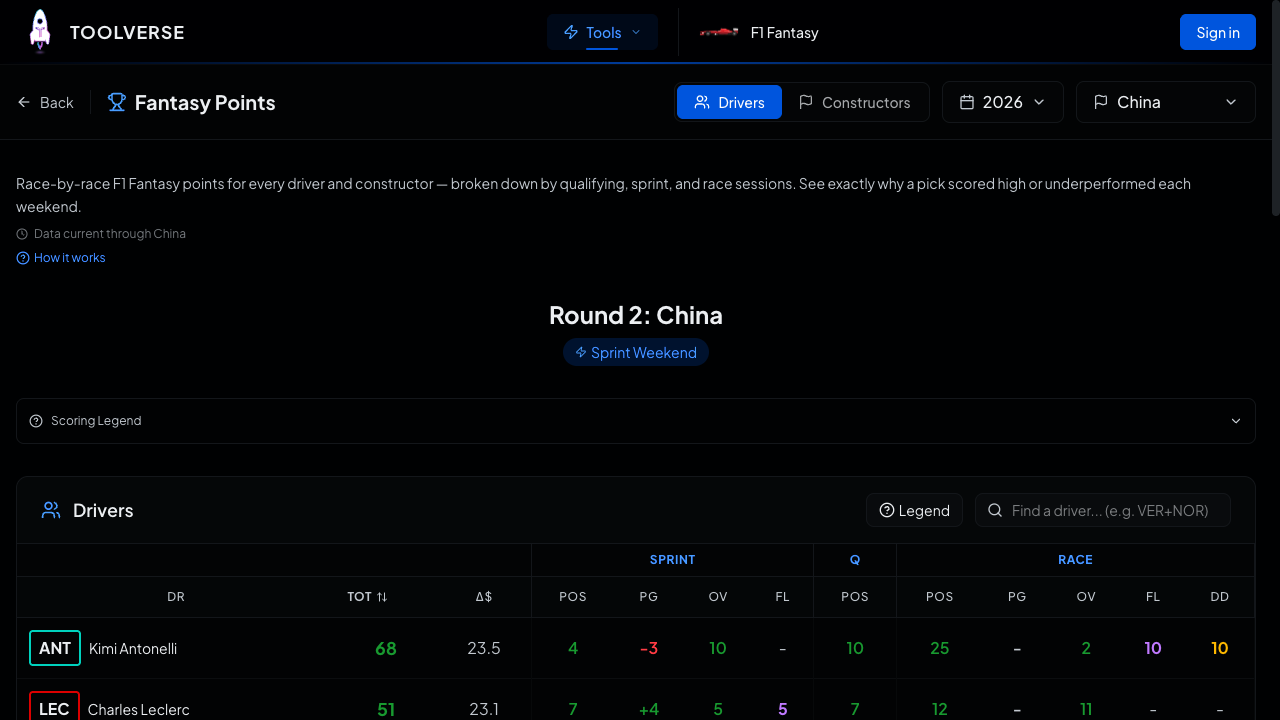 The Apex Team Optimizer accounts for this by blending available session data at each stage, but predictions are naturally less certain with only one practice session.
How Does Sprint Race Scoring Work?
The sprint race is a shorter event (roughly 100km, about one-third of a full race distance) with its own fantasy scoring:
| Category | Points |
|---|---|
| Sprint P1 | 8 |
| Sprint P2 | 7 |
| Sprint P3 | 6 |
| Sprint P4 | 5 |
| Sprint P5 | 4 |
| Sprint P6 | 3 |
| Sprint P7 | 2 |
| Sprint P8 | 1 |
| Sprint P9-P20 | 0 |
| Sprint DNF | -10 (2026 rule) |
| Sprint Fastest Lap | +5 |
The sprint also awards positions gained/lost (+1/-1 per position) and overtakes (+1 per overtake), using the same rules as the main race.
Note the 2026 change: sprint DNFs now cost -10 points instead of -20. This halved penalty makes sprint weekends less risky for volatile drivers who might retire from the shorter race.
How Do Sprint Results Affect Price Changes?
Sprint race points count toward the 3-race rolling PPM (Points Per Million) calculation that determines price changes. This is significant because sprint weekends produce higher total point hauls.
A driver who scores 15 race points and 6 sprint points in the same weekend gets 21 total, compared to 15 on a standard weekend. This higher total pushes their PPM upward, potentially triggering a price rise.
The implication for budget strategy: sprint weekends are prime opportunities for price growth. Drivers who perform well in both the sprint and the race can see their PPM spike, triggering the +$0.6M maximum rise for Tier B drivers. The Budget Boost page factors sprint points into its price change predictions.
Which Drivers Benefit Most From Sprint Weekends?
Not all drivers gain equally from the extra scoring session. Sprint weekends favor specific profiles:
Front-runners who qualify well. Sprint qualifying sets the sprint race grid. Drivers who consistently qualify in the top 5 earn both sprint qualifying points (from the main qualifying on Saturday) and sprint race points. The sprint race has fewer laps for position changes, so grid position matters more than in the full race.
Clean starters. The sprint race start is the best overtaking opportunity in the event. Drivers with a reputation for strong getaways and clean first-lap racing gain positions here. Since the sprint is short, there's less time to recover from a poor start.
Reliable drivers. With the sprint DNF penalty at -10 and the race DNF at -20, unreliable drivers carry a -30 potential downside on sprint weekends versus -20 on standard weekends. Choose drivers with strong mechanical reliability.
Midfield drivers on overtaking-friendly tracks. Sprint races on tracks like Bahrain, China, or Interlagos (which host sprint events) allow midfield drivers to accumulate overtakes. Each overtake is +1 point regardless of whether it's in the sprint or the main race.
When Should You Lock Your Team on Sprint Weekends?
The earlier lock deadline limits your information. Here's how to make the most of what you have:
After FP1 (Friday afternoon)
FP1 is your only practice session. The Apex Team Optimizer switches to after_fp1 stage, blending FP1 pace data (at 30% weight) with historical form. Check:
- Which drivers showed competitive pace
- Any mechanical issues that could affect sprint qualifying
- Tire degradation patterns (relevant for the full race, less so for the sprint)
After Sprint Qualifying (Friday evening)
Sprint qualifying reveals the sprint race grid and gives strong hints about Saturday qualifying pace. If your team isn't locked yet, this is your best data point. The sprint qualifying grid is effectively a qualifying simulation with race-condition strategy. Use it to:
- Confirm or challenge your FP1 impressions
- Identify surprise performers who qualified higher or lower than expected
- Adjust your DRS Boost assignment based on sprint grid position
Lock Decision
Lock your team after reviewing sprint qualifying results if possible. The sprint grid strongly predicts sprint race results because overtaking is harder in a shorter race. A driver starting P2 in the sprint is very likely to finish P1-P3, making their sprint point contribution predictable.
What's the Best Chip Strategy for Sprint Weekends?
Chips interact differently with sprint weekends because of the extra scoring session:
x3 Boost on Sprint Weekends
The x3 chip applies to all scoring sessions, including the sprint. If your x3 driver scores 8 sprint points and 25 race points, they get (8+25) x 3 = 99 points from those categories alone, before qualifying and bonuses. Sprint weekends amplify the x3 chip because there are more points available.
Use x3 on sprint weekends when: a dominant driver is at a track they historically dominate, and the sprint format gives them extra opportunities to score.
No Negative on Sprint Weekends
No Negative floors all negative scores at zero. On sprint weekends, this covers both the sprint DNF (-10) and race DNF (-20). If you're selecting a driver with reliability concerns, No Negative eliminates up to -30 points of downside risk on sprint weekends versus -20 on standard weekends.
This makes No Negative relatively more valuable on sprint weekends, especially at tracks with historically high retirement rates.
Wildcard Timing
Don't waste your Wildcard on a sprint weekend unless you need a complete rebuild. The earlier lock deadline means you have less information to optimize your new team. Save the Wildcard for a standard weekend where you have three practice sessions to evaluate form before locking.
How to Use the Apex Team Optimizer for Sprint Weekends
The optimizer handles sprint weekends automatically. When you select a sprint weekend race:
- Sprint points are included in the predicted total (xPts column)
- Stage options adjust to sprint-specific stages (after_fp1, after_sprint_quali)
- Sprint DNF risk is factored in at the reduced -10 penalty
- Chip simulations include sprint scoring in their calculations
The key difference from standard weekends: the lock stage is after_sprint_quali instead of after_fp3. The optimizer knows this and weights sprint qualifying data at 60% (equivalent to FP3 on standard weekends).
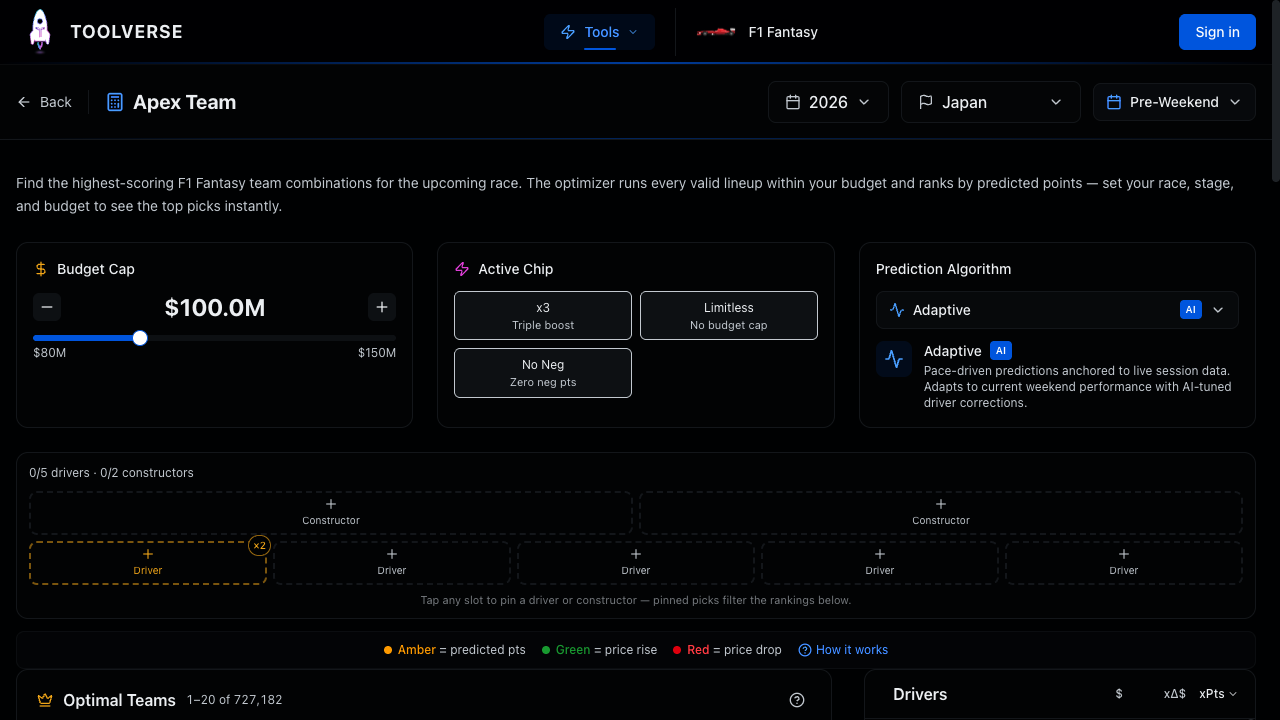
For the most accurate sprint weekend predictions, check the optimizer after sprint qualifying on Friday evening. This gives you the sprint grid and a strong proxy for Sunday qualifying pace.
Sprint Weekend Calendar for 2026
Plan ahead for these sprint weekends where your strategy needs adjustment:
| Round | Grand Prix | Sprint Weekend |
|---|---|---|
| 4 | Bahrain GP | Yes |
| 6 | Miami GP | Yes |
| 10 | Austrian GP | Yes |
| 16 | Spanish GP | Yes |
| 19 | United States GP | Yes |
| 23 | Qatar GP | Yes |
Note: Sprint weekends tend to cluster around tracks with good overtaking opportunities, which amplifies the overtake scoring bonus in both sprint and race sessions.
Frequently Asked Questions
Does the DRS Boost apply to sprint race points too?
Yes. The DRS Boost (x2 multiplier) applies to all scoring across the entire weekend, including sprint race points, positions gained in the sprint, and sprint overtakes. This makes the DRS Boost assignment even more impactful on sprint weekends because there are more points to multiply.
Can I change my team between the sprint and the main race?
No. Once your team is locked before the sprint race, it stays locked for the entire weekend. You cannot make changes between the sprint and qualifying, or between qualifying and the race. Your team selection must work across all remaining sessions.
How many extra points does a sprint weekend typically generate?
Top drivers typically earn 6-10 extra points from the sprint race (finish position + overtakes + positions gained). A sprint P1 with 2 overtakes and 1 position gained = 8 + 2 + 1 = 11 points. For your DRS Boost driver, that's 22 extra points. Across a 5-driver team, sprint weekends can add 20-40 points to your total.
Should I pick different drivers for sprint weekends?
Not necessarily, but you should weight qualifying pace more heavily. Sprint races have fewer laps and less tire degradation, so pure pace matters more than race craft. Drivers who qualify well but sometimes struggle in long races (due to tire management) can actually be better sprint weekend picks.
Plan Your Sprint Weekend Strategy
Sprint weekends are point-scoring opportunities that reward preparation. Check the Apex Team Optimizer after sprint qualifying for the most accurate weekend predictions, review the Fantasy Points page for sprint-specific scoring breakdowns, and read our complete scoring rules guide for every point category explained. New to F1 Fantasy? Start with our beginner's guide.