

How Does F1 Fantasy Scoring Work in 2026?
F1 Fantasy awards points across multiple scoring categories for both drivers and constructors. Your team's total score each race weekend is the sum of all five drivers' individual points plus both constructors' points, with one driver receiving a DRS Boost multiplier. The 2026 season keeps the same core scoring system from 2025, with one key change: sprint race DNF penalties have been reduced from -20 to -10 points.
Every point matters in F1 Fantasy. Understanding exactly how they're awarded lets you make smarter team picks, time your chips better, and squeeze maximum value from each race weekend.
TL;DR: F1 Fantasy scores drivers on qualifying position (1-10 pts), race finish (1-25 pts), positions gained/lost, overtakes, fastest lap (+10), and Driver of the Day (+10). Constructors earn their drivers' combined points plus teamwork bonuses (up to +10) and pit stop points (up to +20). The 2026 change: sprint DNFs now cost -10 instead of -20.
How Are Driver Qualifying Points Scored?
Qualifying points reward grid position after Saturday qualifying. The top 10 earn points on a descending scale:
| Qualifying Position | Points |
|---|---|
| P1 (Pole) | 10 |
| P2 | 9 |
| P3 | 8 |
| P4 | 7 |
| P5 | 6 |
| P6 | 5 |
| P7 | 4 |
| P8 | 3 |
| P9 | 2 |
| P10 | 1 |
| P11-P20 | 0 |
| No qualifying time set | -5 |
Drivers who fail to set a qualifying time (mechanical failure, crash in Q1 without a lap) receive a -5 point penalty. This is rare but can significantly hurt your team if it happens to one of your picks.
Qualifying points make up a substantial portion of a driver's weekly total. A pole-sitter already has 10 points before the race even starts, which is why qualifying pace matters when picking your team.
How Are Driver Race Points Scored?
Race finish position is the biggest single scoring category, using the standard F1 points scale:
| Race Position | Points |
|---|---|
| P1 (Win) | 25 |
| P2 | 18 |
| P3 | 15 |
| P4 | 12 |
| P5 | 10 |
| P6 | 8 |
| P7 | 6 |
| P8 | 4 |
| P9 | 2 |
| P10 | 1 |
| P11-P20 | 0 |
| DNF (Did Not Finish) | -20 |
The -20 DNF penalty is the harshest single-event score in F1 Fantasy. A driver who retires from the race not only misses out on potential race points but actively damages your team's total. This is why reliability matters when selecting drivers. Teams with frequent mechanical issues are riskier picks, regardless of their pace.
Note that the race points mirror the real Formula 1 championship points scale, making it intuitive for F1 fans.
What Are Positions Gained and Lost?
F1 Fantasy rewards drivers who move up through the field and penalizes those who drop back. The calculation compares qualifying position to race finish position:
- Each position gained: +1 point
- Each position lost: -1 point
A driver who qualifies P8 and finishes P4 gains 4 positions = +4 points. A driver who qualifies P2 and finishes P5 loses 3 positions = -3 points.
This scoring category creates an interesting dynamic. Drivers who qualify poorly but race well (strong race pace, good starts, aggressive overtaking) can score heavily here. Conversely, pole-sitters can only lose positions from P1, so they're guaranteed 0 or negative in this category.
This is why "recovery drivers" — those who consistently qualify lower than they finish — can be fantasy gold. They earn race points AND position-gained bonuses.
How Are Overtakes Scored?
Every on-track overtake a driver completes earns +1 fantasy point. This is counted separately from positions gained because a driver can overtake more cars than positions gained if they also get overtaken or if lapped cars are involved.
Overtake scoring particularly favors:
- Drivers at high-overtaking tracks (Bahrain, China, Spa, Interlagos)
- Drivers who start from the back after grid penalties
- Drivers on different tire strategies who carve through the field
At a track like China with its long straight and DRS zones, a midfield driver can rack up 5-8 overtakes in a single race. At Monaco, even 1-2 overtakes is a lot. Track characteristics directly influence this scoring category.
What Bonus Points Exist for Drivers?
Two bonus categories can significantly boost a driver's total:
Fastest Lap
- Race fastest lap: +10 points
- Sprint fastest lap: +5 points
The fastest lap bonus goes to the driver who sets the single fastest lap time during the race. In modern F1, this often goes to a front-runner who pits for fresh soft tires late in the race specifically to claim it. It's worth 10 points, equivalent to a P1 qualifying bonus.
Driver of the Day (DotD)
- Driver of the Day: +10 points
DotD is voted on by fans during the race. It typically goes to drivers who put on an entertaining performance — big overtaking moves, strong recovery drives, or unexpected results. Unlike fastest lap, DotD is unpredictable because it's fan-voted. However, historical patterns show it tends to go to drivers who either won from a difficult position or made dramatic progress through the field.
How Does Sprint Weekend Scoring Work?
Sprint weekends add extra scoring sessions to the regular weekend format. In 2026, sprint weekends follow this schedule:
| Session | Scoring |
|---|---|
| Sprint Qualifying | No fantasy points |
| Sprint Race | P1-P8 score points |
| Regular Qualifying | Standard qualifying points |
| Regular Race | Standard race points |
Sprint race points use a compressed scale:
| Sprint Position | Points |
|---|---|
| P1 | 8 |
| P2 | 7 |
| P3 | 6 |
| P4 | 5 |
| P5 | 4 |
| P6 | 3 |
| P7 | 2 |
| P8 | 1 |
| P9-P20 | 0 |
| Sprint DNF | -10 (new for 2026, was -20) |
| Sprint Fastest Lap | +5 |
The 2026 rule change reducing sprint DNF penalties from -20 to -10 is significant. Previously, a sprint DNF was as costly as a race DNF, which felt disproportionate for a shorter event. The halved penalty makes sprint weekends slightly less risky for selecting aggressive drivers.
Sprint weekends also award positions gained/lost and overtakes during the sprint, using the same +1/-1 per position and +1 per overtake rules.
How Are Constructor Points Calculated?
Constructor scoring combines their two drivers' points with constructor-specific bonuses in two categories: teamwork and pit stops.
Teamwork Bonus
The teamwork bonus rewards teams whose drivers both perform well in qualifying:
| Both Drivers' Qualifying Result | Bonus |
|---|---|
| Both reach Q3 (P1-P10) | +10 |
| One reaches Q3 | +5 |
| Both reach Q2 (P11-P15) | +3 |
| One reaches Q2 | +1 |
| Neither reaches Q2 | -1 |
Top teams like McLaren, Ferrari, and Red Bull almost always get both drivers into Q3, earning a consistent +10 teamwork bonus each weekend. Midfield teams that regularly split between Q2 and Q3 earn +5. Backmarker teams struggle to get either driver beyond Q1, earning -1.
This bonus makes top constructors disproportionately valuable in fantasy. A +10 teamwork bonus every race adds 240 points across a 24-race season.
Pit Stop Points
Pit stop scoring rewards fast, clean pit stops:
| Fastest Pit Stop Time | Points |
|---|---|
| Under 2.0 seconds | 20 |
| 2.0s - 2.19s | 10 |
| 2.2s - 2.49s | 5 |
| 2.5s - 2.99s | 2 |
| 3.0s or slower | 0 |
Additional bonuses:
- Fastest pit stop of the race: +5
- World record pit stop: +15
Pit stop points are scored per pit stop (a team can earn points from multiple stops) and apply to the constructor, not individual drivers. Teams like Red Bull and McLaren, known for consistently sub-2-second stops, regularly earn 20-25 pit stop points per race.
Disqualification Penalties
If a driver is disqualified from a session, their constructor takes a penalty:
| Disqualification | Constructor Penalty |
|---|---|
| Qualifying DQ | -10 per driver |
| Race DQ | -30 per driver |
| Sprint DQ (2026) | -20 per driver |
DQ penalties are rare but devastating. A race DQ costs -30 points from the constructor, on top of the driver losing all their race points.
How Does the DRS Boost Multiplier Work?
Every team has one DRS Boost slot. The driver you assign as your DRS Boost receives a x2 multiplier on all their points for that race weekend. If you activate the x3 chip, your top driver gets x3 and your second-highest scorer gets x2.
The DRS Boost decision is the highest-leverage choice you make each week. Assigning it to a driver who scores 30 points gives you 60 total (or 90 with x3). Assigning it to a driver who scores 10 gives you only 20.
The Apex Team Optimizer automatically assigns the DRS Boost to the predicted highest scorer, but you can override this if your own analysis disagrees.
What Changed in 2026 Compared to 2025?
The 2026 season has one confirmed scoring change:
| Category | 2025 | 2026 |
|---|---|---|
| Sprint DNF penalty | -20 points | -10 points |
All other scoring categories remain identical. This means your 2025 scoring knowledge transfers directly. The sprint DNF reduction slightly increases the expected value of volatile drivers on sprint weekends, since the downside risk is halved.
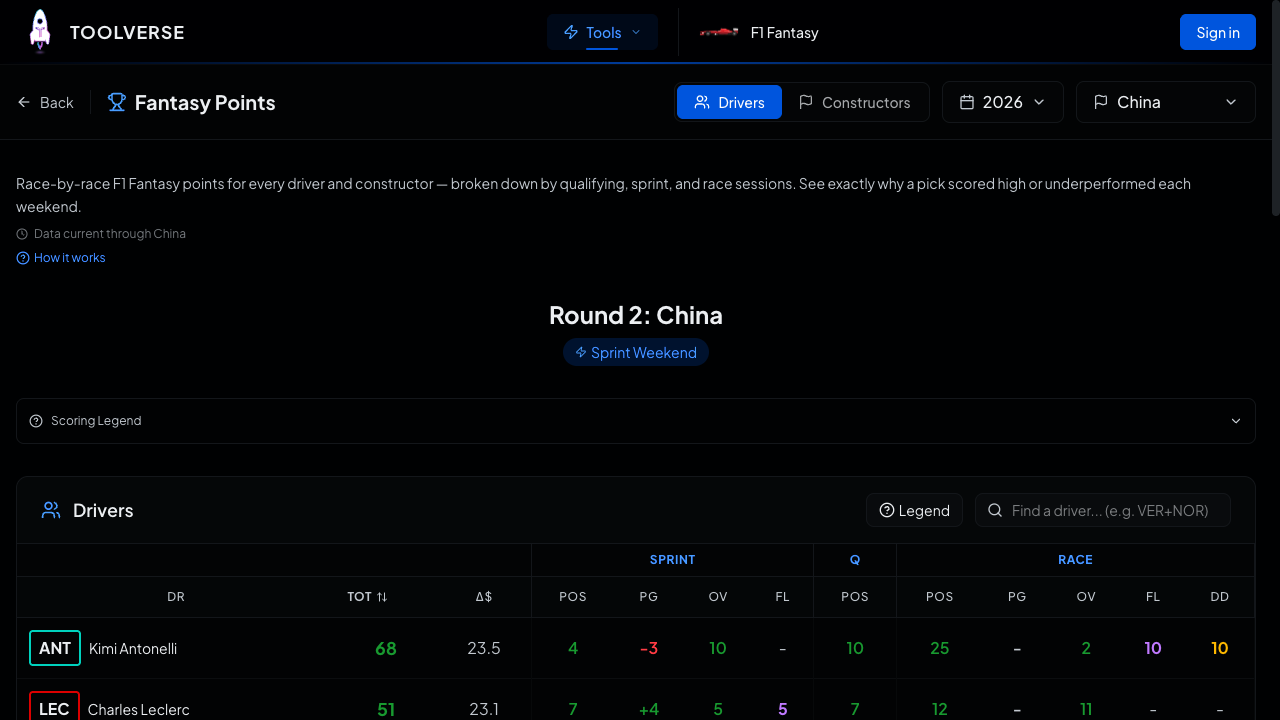
For detailed scoring data from every race this season, visit the Fantasy Points page where you can see per-category breakdowns for each driver and constructor.
Frequently Asked Questions
Do qualifying points change if there's a grid penalty after qualifying?
No. Fantasy qualifying points are based on the qualifying session result, not the final grid position after penalties. A driver who qualifies P3 but takes a 5-place grid penalty still earns 8 qualifying fantasy points. However, their race starting position (P8) affects positions gained/lost calculations.
Does the fastest lap point go to any driver or only those in the top 10?
In the real F1 championship, the fastest lap point only counts if the driver finishes in the top 10. In F1 Fantasy, the +10 fastest lap bonus is awarded to whoever sets the fastest lap regardless of their finishing position. This is an important distinction.
How are positions gained calculated if a driver DNFs?
A DNF driver receives the -20 race penalty but does not receive additional position-lost penalties. The positions gained/lost calculation uses their classified finishing position, or if they're not classified, their qualifying position is compared to their last completed race lap position.
Can I see a breakdown of each scoring category per driver?
Yes. The Fantasy Points page shows a detailed per-category breakdown for every driver and constructor, every race. You can see exactly how many points came from qualifying, race position, overtakes, positions gained, fastest lap, and DotD.
Are there any scoring differences between the first race and later races?
No. All scoring rules apply identically from Race 1 through Race 24. The only early-season consideration is that some bonus categories (like fastest lap patterns) have less historical data to predict from.
Use Scoring Knowledge to Build Better Teams
Understanding the scoring system is the foundation of every good F1 Fantasy strategy. Once you know which categories drive the most points, you can target drivers and constructors who excel in those areas. Check the Fantasy Points page for per-race breakdowns, use the Apex Team Optimizer to find the highest-scoring lineups, and read our beginner's guide to F1 Fantasy for a complete introduction to the game.