

How Do F1 Fantasy Price Changes Work?
F1 Fantasy adjusts driver and constructor prices after every race weekend based on a metric called Points Per Million (PPM). PPM measures how many fantasy points a player scores relative to their price over a rolling 3-race window. Drivers who consistently outperform their price tag rise in value. Those who underperform drop. Understanding this system is the single most important skill for growing your budget beyond the starting $100M cap.
Price changes happen automatically after each race. You can't control them directly, but you can predict them by calculating which drivers are likely to exceed or fall below the PPM thresholds that trigger changes.
TL;DR: F1 Fantasy prices change based on Points Per Million (PPM), calculated over a rolling 3-race average. Drivers priced at $19M+ see smaller swings (plus or minus $0.1-0.3M), while budget drivers under $19M see larger swings (plus or minus $0.2-0.6M). Predicting these changes lets you grow your budget by buying underpriced drivers before they rise.
What Is Points Per Million (PPM) and How Is It Calculated?
PPM is the core formula behind every price change in F1 Fantasy. It divides a driver's total fantasy points over the last 3 races by their current price multiplied by the number of races in the window.
The formula:
PPM = (Points from Race 1 + Race 2 + Race 3) / (3 x Current Price in Millions)
For example, if Lando Norris is priced at $25M and scores 22, 18, and 28 points over three races:
- Total points: 68
- PPM = 68 / (3 x 25) = 68 / 75 = 0.91
That 0.91 PPM falls into the "good" bracket, meaning his price would rise by $0.1M.
The PPM Threshold Table
F1 Fantasy uses different price change amounts depending on whether a driver is in Tier A (premium, priced $19M or above) or Tier B (budget, priced under $19M):
| PPM Range | Tier A ($19M+) Change | Tier B (Under $19M) Change |
|---|---|---|
| 1.2 or higher | +$0.3M | +$0.6M |
| 0.9 to 1.19 | +$0.1M | +$0.2M |
| 0.6 to 0.89 | -$0.1M | -$0.2M |
| Below 0.6 (Tier A) / Below 0.4 (Tier B) | -$0.3M | -$0.6M |
Notice the asymmetry: Tier B drivers have double the price swing of Tier A drivers. A budget driver having a great run can gain $0.6M per race, while a premium driver in the same form gains only $0.3M. This asymmetry is the foundation of budget growth strategy.
Why Do Tier B Drivers Have Bigger Price Swings?
The tier system exists to balance the market. Premium drivers ($19M+) are already expensive and tend to score consistently. Their smaller price swings prevent runaway inflation. Budget drivers under $19M have more volatile results and bigger price movements, which creates opportunity.
A Tier B driver who strings together three strong races at 1.2+ PPM gains $0.6M each time, adding $1.8M to your budget across three weeks. The same performance from a Tier A driver nets only $0.9M. That's why experienced players load up on underpriced Tier B drivers early in the season. They're budget multipliers.
There's also a price floor at $4.5M, so no driver can drop below that level regardless of how poor their PPM is.
How Does the 3-Race Rolling Average Affect Strategy?
The rolling window is what makes price prediction both possible and tricky. Because PPM looks at the last 3 races, a single great weekend doesn't guarantee a price rise if the previous two were poor. Conversely, one bad race won't crash a driver's price if they performed well in the prior two.
This creates a predictable pattern:
Early season (Races 1-3): The rolling window is still building. After Race 1, PPM uses only 1 race of data. After Race 2, it uses 2. This makes early-season price changes more volatile and harder to predict. A single standout performance can trigger a maximum price rise.
Mid-season (Races 4-12): The full 3-race window is active. Price changes become more predictable because you can see exactly which race is about to "drop off" the window. If a driver scored 30 points three races ago and that race is about to exit the window, their PPM will drop unless they score at least as well.
Late season (Races 13+): Prices stabilize further. Most drivers settle into predictable PPM ranges. The biggest opportunities come from form changes, like a team introducing a major car upgrade that boosts their driver's results.
The "Drop-Off" Calculation
Here's the key insight: you already know two of the three races in the next PPM calculation. After Race 8, the rolling window covers Races 6, 7, and 8. When Race 9 completes, it will cover Races 7, 8, and 9. Race 6's points "drop off" the window.
If a driver scored 30 points in Race 6 but only 15 in Race 9, their PPM drops. If they scored 10 in Race 6 and 25 in Race 9, their PPM rises. You can calculate exactly how many points a driver needs in the upcoming race to hit each PPM threshold.
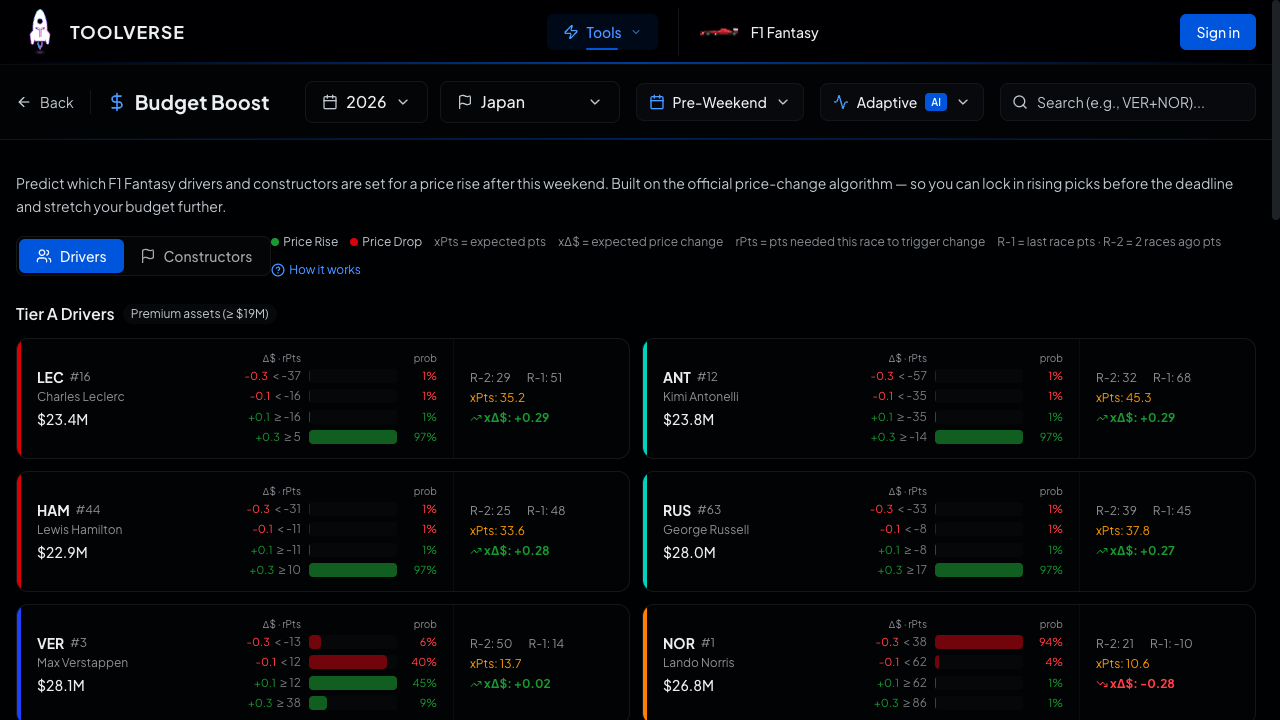
The Budget Boost page does this calculation for you, showing the exact points needed (rPts) for each price change bracket.
How to Predict Which Drivers Will Rise in Price
Predicting price changes comes down to estimating how many points a driver will score in the upcoming race and plugging that into the PPM formula with their known scores from the previous two races.
Here's the step-by-step process:
Step 1: Check Recent Scores
Look at the driver's fantasy points from the last two completed races (R-2 and R-1). These are fixed and already part of the rolling window.
Step 2: Calculate Points Needed
Use the PPM formula in reverse. For a Tier A driver priced at $22M to get a +$0.3M rise, they need a PPM of 1.2 or higher:
Required points = (1.2 x 3 x 22) - R2_points - R1_points
If they scored 20 (R-2) and 18 (R-1):
- Required = 79.2 - 20 - 18 = 41.2 points
That's an extremely high bar, so a +$0.3M rise is unlikely. But for +$0.1M (0.9 PPM threshold):
- Required = (0.9 x 3 x 22) - 20 - 18 = 59.4 - 38 = 21.4 points
A score of 22+ in the next race would trigger a price rise. That's very achievable for a top-tier driver.
Step 3: Estimate Likely Score
Estimate the driver's expected points based on:
- Their recent qualifying and race pace
- Track characteristics (high-overtake vs. low-overtake)
- Weather conditions
- Free practice session results (if available)
Or use the Apex Team Optimizer, which runs 10,000 Monte Carlo simulations per driver to estimate expected points with confidence intervals.
Step 4: Compare Expected Score to Required Points
If the expected score exceeds the required points for a price rise, that driver is a good buy before the race. If it falls below the threshold for a price drop, consider selling before their value decreases.
How Does Budget Boost Predict Price Changes?
The Budget Boost page automates this entire process with probability distributions instead of single-point estimates.
For each driver and constructor, Budget Boost shows:
- Probability bars for each price change outcome (+$0.6, +$0.2, -$0.2, -$0.6 for Tier B; +$0.3, +$0.1, -$0.1, -$0.3 for Tier A)
- Required points (rPts) for each bracket, accounting for the rolling average
- Expected price change (xDelta) as a probability-weighted average
- Historical scores from the last 2 races for context
The probability distributions come from the same Monte Carlo engine as the Apex Team Optimizer. Rather than saying "this driver will rise," it might show: 45% chance of +$0.2, 30% chance of no change, 20% chance of -$0.2, 5% chance of -$0.6. This honest uncertainty helps you make better decisions.
Budget Boost separates drivers into Tier A (premium, $19M+) and Tier B (budget, under $19M) tabs, since the price change thresholds differ between tiers.
What's the Best Budget Growth Strategy?
The most effective approach combines price prediction with the natural asymmetry of the tier system:
Weeks 1-4: The Budget Growth Phase
Prioritize Tier B drivers with high predicted PPM. Their $0.6M max rise per race means your budget can grow fast. Even if they score slightly fewer fantasy points than a Tier A alternative, the budget growth sets you up for stronger teams later.
Target drivers who:
- Sit just below the $19M Tier A threshold (e.g., $17-18M)
- Have shown improving form (new upgrades, better car)
- Race at tracks that suit their car's strengths
- Have easy "drop-off" races (low-scoring races leaving the rolling window)
Weeks 5-8: The Transition Phase
Once your budget reaches $103-105M, start shifting focus. Keep one or two Tier B risers for continued growth, but move the rest of your budget into high-scoring Tier A drivers. The extra $3-5M from your growth phase lets you pick up an elite driver you couldn't previously afford.
Weeks 9+: The Points Phase
With a healthy budget ($105M+), optimize purely for points. Use the Apex Team Optimizer to find the highest-scoring lineup within your grown budget. The budget advantage compounds over the season. A player with $107M has access to team combinations that a $100M player simply can't build.
When Do Price Changes Take Effect?
Price changes are applied after each race weekend, typically by Monday morning. The new prices are reflected in the official F1 Fantasy game before the next team lock deadline.
Important timing notes:
- Team lock deadline (regular weekends): Right before qualifying on Saturday
- Team lock deadline (sprint weekends): Right before the sprint race on Saturday
- Price change applied: After the race on Sunday
This means you need to make your buy/sell decisions before the team locks, based on your predictions for the upcoming race. You can't wait to see the results and then trade.
Sprint weekends are particularly interesting because there are extra scoring sessions. The sprint race itself awards points that count toward PPM calculations, but the team lock happens before the sprint, so the sprint results can create unexpected price movements.
Common Mistakes in Price Prediction
Ignoring the drop-off race. Players often look only at recent performance without checking which race is leaving the 3-race window. A driver might look like they're in great form, but if a 35-point race is dropping off and the replacement race yields only 15 points, their PPM crashes.
Forgetting the tier boundary. When a driver's price crosses $19M (up or down), they switch tiers. A driver at $18.8M who rises $0.6M (Tier B maximum) jumps to $19.4M and enters Tier A, where future rises are capped at $0.3M. This can affect long-term growth calculations.
Overreacting to one race. Early in the season (Races 1-2), a single result has outsized impact on PPM because the rolling window is still building. By Race 4+, one bad race is smoothed out by two good ones. Don't panic-sell after one DNF mid-season.
Neglecting constructor price changes. Constructors follow the same PPM system but their scoring includes teamwork bonuses and pit stop points, making their price movements less intuitive. Don't overlook them.
Frequently Asked Questions
Do price changes affect my existing team or only new purchases?
Price changes affect the market value of all drivers and constructors, including those already on your team. If a driver on your team rises by $0.3M, your team's total value increases and you gain selling headroom. If they drop, your team value shrinks. This matters when you want to make transfers later.
Is there a maximum price a driver can reach?
There's no official price ceiling, but in practice, even the best drivers rarely exceed $30-32M over a full season. The $0.3M maximum weekly rise for Tier A drivers limits how fast prices can climb.
Can I see price change history for each driver?
Yes. The Standings page shows price history for every driver and constructor across the season, including their current price trend direction and total price movement.
How accurate are the Budget Boost price predictions?
Budget Boost uses Monte Carlo simulations (10,000 iterations per driver) to model outcome probability. The predictions become more accurate as the weekend progresses. After FP3, when session pace data is available, the model has significantly better visibility into qualifying and race outcomes.
What's the minimum price a driver can drop to?
The price floor is $4.5M. No driver or constructor can drop below this level, regardless of their PPM. This means heavily underperforming drivers eventually stop losing value, which can actually make them interesting recovery picks if their form improves.
Build Your Price Prediction Strategy
Price management separates casual F1 Fantasy players from competitive ones. The PPM system is deterministic once you know the inputs, which means price changes are predictable with the right data. Use the Budget Boost page to see probability-weighted predictions for every driver before each race, and read our complete beginner's guide if you're just getting started with the game.